
Subdeacon Joe
-
Posts
53,524 -
Joined
-
Last visited
-
Days Won
632
Content Type
Profiles
Forums
Events
Everything posted by Subdeacon Joe
-
Somehow I don't think you'd be shooting Bullseye Pistol using a .25 ACP with a 2" barrel. More like 3 yards "point 'n click interface," looking over the top of the slide.
-
We also saved millions of Japanese civilian lives. See my post above about projected Japanese casualties if there had been an allied invasion. Or, if some had suggested, we embargoed Japan, tens of millions through starvation and disease. Two other points, how is it different than the conventional bombing of other cities? And both Hiroshima and Nagasaki were significant ports, rail junctions, military staging areas, as well as medium manufacturing centers.
-
Or two Hungarians.
-
-
One of the great voices of our time.
-
I like a little butter or oil in mine. I think it gives a nicer crumb. But when I make it for church (either small loaves for a Lity, or to use for the zapivka) I leave it out.
-
I've never heard it used like that before. "Groceries" comes from "grocer" which comes from "groser," one who deals in bulk foodstuffs.
-
https://youtu.be/6-fXNHSDxmE?si=C2r9dPVaumNzdY0D
-
Thanks. I watched the first movie around '03 or '04. Never been tempted to do it again.
-
https://www.instagram.com/reel/DFIyDsrIzx9/?igsh=MzRlODBiNWFlZA==
-
OK, I'm guessing that's someone famous from some really popular movie. That's as close as I can come.
-
Probably not all that far off. I know that I and two of my brothers would likely not be here. Operation Downfall was scheduled to kick off on 1 November of 1945. Figure everyone who was born after July 1946 and has a Marine father wouldn't be here. Here's the Order of Battle for that Operation.
-
I kinda think of it as The Day That Saved Japan. If it hadn't worked and the Allies had to carry out Operation Downfall, Japan would likely have had 3,000,000 to 5,000,000, some say up to 10,000,000) Japanese deaths from direct military a tion. Add in millions more from disease and starvation.
-
-
-
-
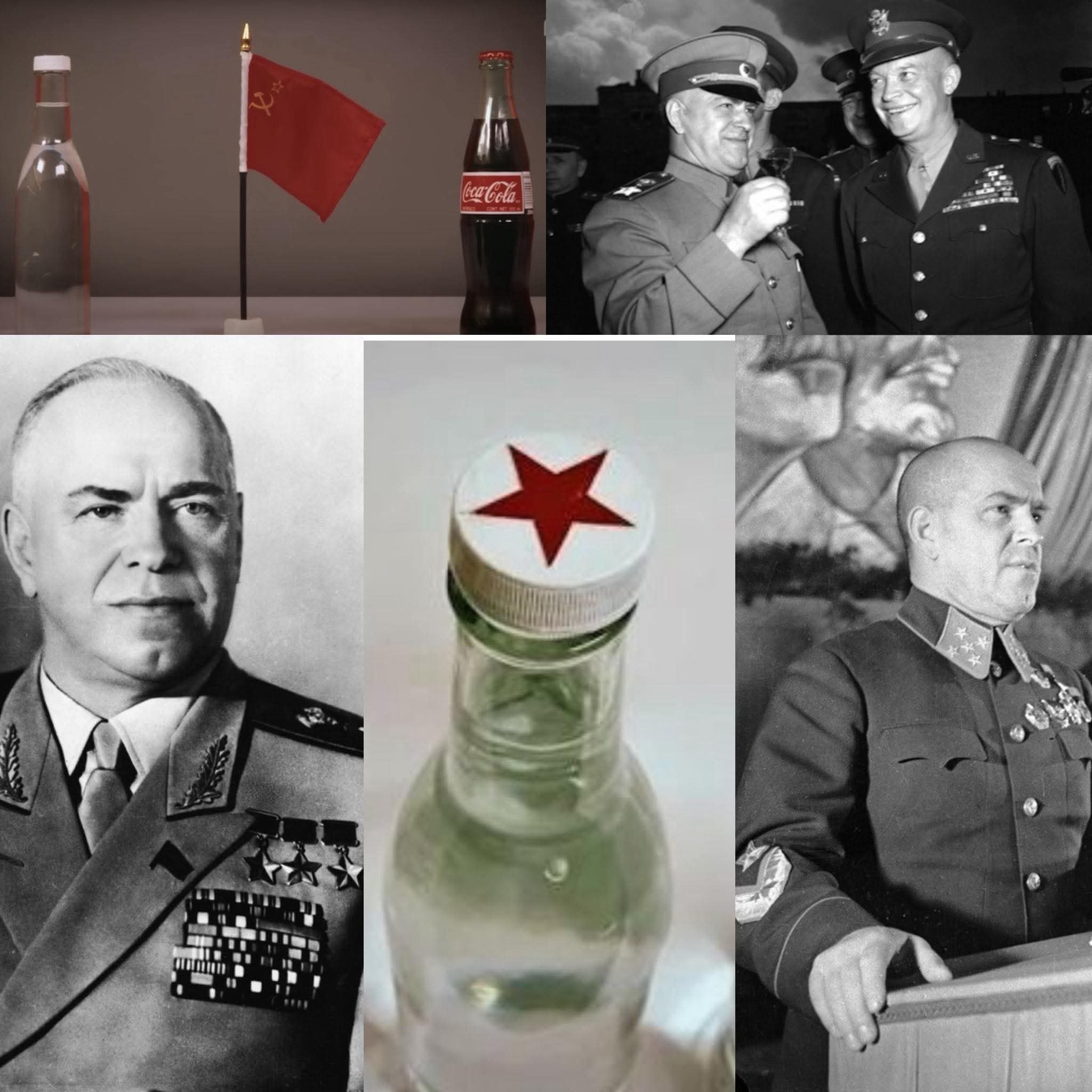
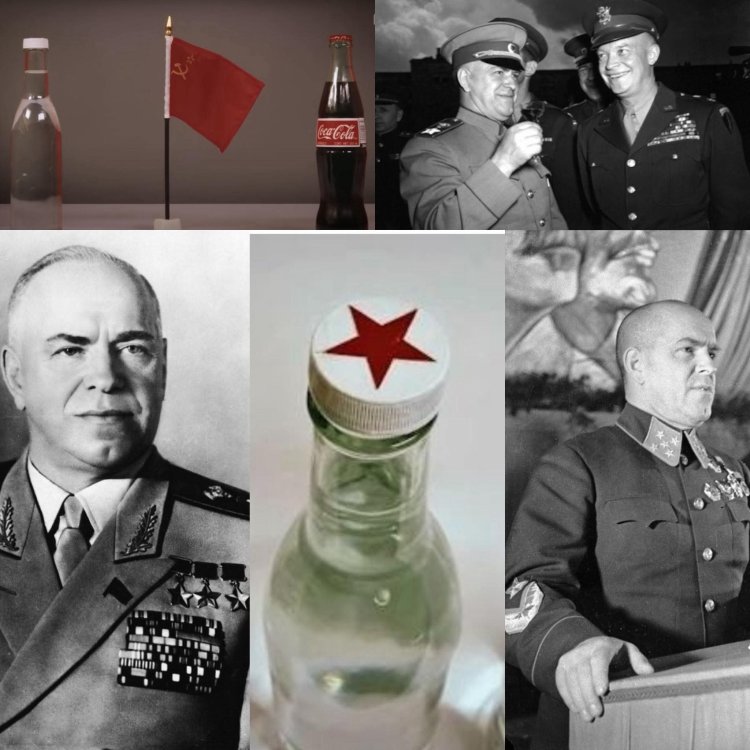
the United States secretly used to make a white clear Coca Cola specifically for General Zhukov after World War I| . It had the same flavor as the original, virtually unchanged by the absence of caramel coloring. After the end of World War II, General Eisenhower introduced General Zhukov to Coca Cola (Coke) for the first time. Zhokov absolutely fell in love with Coke and couldn't get enough of it. Unfortunately for General Zhukov, Coke was illegal in the Soviet Union and therefore he couldn't be seen enjoying the lovely soda. Zhukov asked his American counterpart, General Mark Clark if there was a way to produce Coke without the coloring. Clark passed on this request to President Truman who tasked Coke with making a colorless Coke that was packaged to resemble Vodka. Truman contacted Coke and asked them to create a colorless Coke that tasted the same, but was packaged to look exactly like a clear bottle of vodka. The colorless version of Coca-Cola was bottled using straight, clear glass bottles with a white cap and a red star in the middle. One unusual consequence for the Coca-Cola Company was a relaxation of the regulations imposed by the occupying powers in Austria at the time. Coca-Cola supplies and products were required to transit a Soviet occupation zone while being transported between the Lambach bottling plant and the Vienna warehouse. While all goods entering the Soviet zone normally took weeks to be cleared by authorities, Coca-Cola shipments were never stopped.
-
Yeah...his almost detached but still passionate narrative is amazing. Superb camera work and editing, too.
-
Each branch has a military ball (navy ball, army ball, etc) And it warms my heart to know that one branch will be having"Space Balls" from here on out
-
Try "Basturma." It's easy to make, but time consuming.
-
 Shave?
 -
I was pretty sure that was what you meant, but thought I'd cover the other just in case.