
Subdeacon Joe
-
Posts
58,837 -
Joined
-
Last visited
-
Days Won
692
Content Type
Profiles
Forums
Events
Posts posted by Subdeacon Joe
-
-

-
 1
-
 6
-
-
7 minutes ago, Smokin Gator SASS #29736 said:
On the day Trump was inaugurated in 2017
That civil war started on election night in 2016. Heck, the riots blocked on and off ramps, blocked roads to try to shut down his campaign rallies during the 2016 campaign were skirmishes before the all out war. There were only a tiny percentage of the active rioters, looters, arsonists, etc. that were brought to trial.
But, to the subject of the Bidens being pardoned:

-
1
-
-
Cajon Pass Brown Improves Toll Road
In the latter part of 1874, John Brown finally decided to make some improvements to the turnpike, a decision no doubt spurred for the most part by the explosion of activity created by the Panamint mines, and the constant flow of traffic between there and the Southern Pacific railhead at Spadra. The increase in toll collections from this traffic was substantial enough to support a major reconstruction on the steepest segment of the road near the summit.

The cut at the summit reduced the grade making it easier to pass.
In September Brown promised to relocate the road, so that teams could "go through the low gap to the right of the top of the hill, thereby avoiding the high ascent of the present road." He also planned to improve the new route by blasting a 185-foot segment in order to reduce the grade even further. In early December it was reported that a "splendid highway" was under construction, and Brown announced he would "spare no expense in improving it to perfection." On December 28th the San Bernardino Weekly Argus gave a glowing account of the project:-
THE NEW ROAD -- The new road being built by Mr. Brown is certainly a great improvement. It intercepts the toll road about a mile above Fear's station and runs in a direct line for Panamint and is nearer Bear and Holcomb valleys, and other mining districts, than the old road.
Mr. Brown has had considerable experience in road building and has selected an excellent grade over the summit, perfectly straight, and wide enough for teams to pass each other nearly all the way. The summit is a hard cement formation and has to be blasted. Several cuts are being made and hollows filled, some a long distance. The work was finished in early February, and Brown, in an ebullient mood, said, "I wish...to inform the traveling public that the so-much-talked-of new wagon road through the Cajon Pass, is finished, the last spike driven."
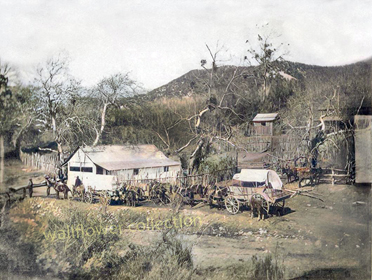
Original upper toll station - 1863
Courtesy Feldheym Library
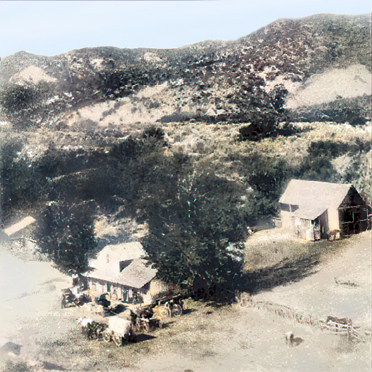
This toll station at the upper gate was built after the original was destroyed by fire on June 4, 1876 (colorized)
-=--
 5
-
THE NEW ROAD -- The new road being built by Mr. Brown is certainly a great improvement. It intercepts the toll road about a mile above Fear's station and runs in a direct line for Panamint and is nearer Bear and Holcomb valleys, and other mining districts, than the old road.
-
Have my passenger call police as soon as the guy got out with a gun in his hand. Make sure to get the guys face and license plate on video.
Put it in gear and tromped on the accelerator and gone right for the attacker.
-
5
-
-
I don't think she got them for the ones in her trunk.
-
2
-
 1
-
-
-
-
-
I still want someone to make a .45-47 wildcat round.
-
1
-
6
-
-
I don't know why, but I had expected an acapella rendition.
I like how she made it "the people's moment" with her 'Help me out here" line. Americans helping Americans. Beautiful.-
6
-
-
-
-
-
1
-
1
-
-
8 minutes ago, Wild Eagle said:
I don't know how accurate this is for the city folk, but for living on a farm it's pretty close to how I grew up.
The city folks is an over exaggerated caricature of an extremely liberal parent.
-
2
-
-
51 minutes ago, John Kloehr said:
Funny, but best to do some reading before trying a citizens arrest. It is not for minor and petty things. Unless the crime meets certain standards (varies by state), the arresting citizen may end up facing charges for the attempt.
About it in California:
https://www.egattorneys.com/citizens-arrest-penal-code-837
Considering the violence LEOs face when making an arrest, I think trying to make a citizens arrest would ve rather foolhardy, unless it's in your home and you have an intruder on the floor at gunpoint.
-
2 hours ago, Rye Miles #13621 said:
Whatever happened to citizens arrest?
-
1
-
-
-
-
1 hour ago, Pat Riot said:
You can’t thicken up your blood for winter by hiding indoors in the heat.
From the movie "Becket," I think "To fight the cold you must use the cold's own weapons. Every morning wash yourself with cold water. "
-
2
-
-
Different people, individuals, deal with heat and cold differently.
Now, my ancestry is British Isles and Eastern European. 47°F and a short walk? Why bother to bundle up? I usually do my grocery shopping early in the morning. A few weeks ago at 0545 it was 30°F. Lightweight pants, sandals, sports shirt. Car heats up quickly. Walking into the overheated store takes a minute. Why bundle up? My brothers will throw on 4 layers of clothes for the same things.
Maybe those people were from Mini-Soda or Wes-Kaan-sin and were used to cold.
-
1
-
-
28 minutes ago, Alpo said:
I think AI got in there a little bit.
Look at Zeppo's nose. The shape of his nose going up into the eye sockets. That is not human. He looks like he's wearing science fiction alien makeup.
Look at Groucho's eyes.
Harpo's face looks like Harpo, but look at his ears.
Chico's ears are also funny, although not as bad as Harpo's. But the shadow along the jawline on the right side of his face. It looks like somebody glued a picture of his face on somebody else's head.
Trick if the lights and camera angle. Or bad retouching oh the photo.


-
2
-
-

Eggplant
-
2
-
4
-
-

The photo is a study in contrasts, a paradox frozen in time. Four sharply dressed gentlemen—suits tailored to perfection, hair slicked back with precision—stand together in a way that almost dares you to believe their solemnity. They could be Wall Street bankers preparing for a power lunch or a secret society on the verge of revealing their clandestine mission. Their polished demeanor, however, masks the chaos they’re truly known for. If you looked at this picture without context, you’d never guess that these four men—Chico, Harpo, Groucho, and Zeppo Marx—were among the most wildly unconventional comedic geniuses Hollywood and Broadway had ever seen.
Taken in 1924, during the height of their Broadway success in *I’ll Say She Is*, this photo captures the Marx Brothers in an unusual light. Their usual antics—Harpo’s silent but chaotic mischief, Chico’s malapropisms delivered in a thick Italian accent, Groucho’s razor-sharp wit punctuated by his painted-on mustache, and Zeppo’s straight-man charm—are nowhere to be found. Instead, they appear subdued, almost ordinary. But “ordinary” was the last word anyone who saw them perform would use.
The Marx Brothers were at a crossroads in 1924. They had spent years honing their act in vaudeville theaters, where success was earned through grit and relentless innovation. Vaudeville was their boot camp, and by the time they arrived on Broadway, they were seasoned performers with an uncanny ability to read an audience. *I’ll Say She Is* was their breakout show, a revue-style production that defied conventional storytelling in favor of anarchic humor. It was a perfect vehicle for their unique talents, and its success marked the beginning of their ascent to stardom.
But their rise wasn’t without its challenges. The transition from vaudeville to Broadway demanded a level of polish and sophistication that didn’t come naturally to the brothers, whose humor was rooted in spontaneity and improvisation. Offstage, they were just as irreverent as their onstage personas. Groucho Marx’s daughter, Miriam, once recounted how her father’s transformation for a role made him unrecognizable. Dropping her off at school in full makeup and costume, Groucho looked so different that teachers and students alike failed to connect him to the witty, mustachioed figure audiences knew and loved.
The photograph, then, is a momentary glimpse of their duality. Dressed to the nines, they could pass for serious men, men of purpose. But beneath the polished exterior lay the raw energy of performers who thrived on subverting expectations. Chico, with his quick fingers on the piano and thick accent, often played the lovable hustler. Harpo, in contrast, communicated volumes without saying a word, relying on his expressive face, physical comedy, and an array of bizarre props. Groucho, the sarcastic leader, was a master of verbal acrobatics, his rapid-fire delivery packed with double entendres and biting commentary. And Zeppo, the “straight man” of the group, was the glue that held their madness together, grounding their antics just enough to keep the audience from spiraling into chaos.
By 1924, their Broadway success was paving the way for Hollywood, where they would achieve even greater fame in films like *Duck Soup* and *A Night at the Opera*. These movies cemented their legacy, showcasing their ability to blend absurdity with social commentary. They became icons not just of comedy but of a particular kind of rebellion—a refusal to conform to societal expectations, a celebration of wit and cleverness over decorum.
The photo is remarkable not only for its rarity but for what it represents. It is a snapshot of transformation, a moment before the world truly knew who these “gents” were. It’s hard to reconcile their serious poses with the chaos they would unleash on stage and screen, but perhaps that’s the point. The Marx Brothers were masters of disguise, not just in their costumes and roles but in their ability to navigate different worlds—vaudeville, Broadway, and eventually Hollywood—without losing the essence of who they were.
So when you look at this photo, you might ask, “Who are these gents?” And the answer, much like their comedy, is a punchline that surprises you every time: They’re the Marx Brothers, and they changed the world by refusing to take it too seriously.

-
1
-
5
-
1
-
-
In the summer of 1963, a film was born that had little interest in being taken seriously. It wasn’t about pushing cinematic boundaries or breaking new ground; it was about having fun. The movie was *Donovan’s Reef*, the final collaboration between two cinematic giants—John Wayne and director John Ford. But this wasn’t going to be one of their epic Westerns, with morality and honor at stake. No, this one would be something different, something lighter, a chance for a good time with friends.
Ford, a man known for his epic films like *The Searchers* and *The Quiet Man*, had already made his mark on the Hollywood landscape. But after decades of serious work, Ford wanted a break. What better way than to go to Hawaii with a group of people he liked and make a movie for the sheer enjoyment of it? Ford’s script was hardly the focus. Instead, it was the camaraderie between the actors that took center stage, each bringing their unique energy to the screen.
Lee Marvin, a man who had become famous for his tough guy roles and razor-sharp wit, was cast as Gilhooley. But this role wasn’t about deep character work. Marvin didn’t need to spend nights analyzing motivations. Ford simply told him: “Take the role. It doesn’t matter what the story is. Just have fun.” The idea was to get out of the routine, let go of the pressure of high expectations, and enjoy the luxury of a paid vacation in paradise. For Marvin, that meant turning the film into a roughhouse comedy—a playground where he could do whatever he wanted. He brought his signature energy to the film, playing Gilhooley with a carefree bravado that matched the sun-soaked atmosphere of the Hawaiian islands.
But the real beauty of *Donovan’s Reef* lay in its laid-back spirit. It was a chance for Wayne, a man known for playing stoic, larger-than-life heroes, to relax and let loose. He wasn’t being asked to embody the weight of the American frontier or the tragic hero of a John Ford Western. Instead, Wayne could just be himself—a man enjoying the warmth of the islands, with a drink in hand and a laugh in the air. It was a chance to play, to bond with old friends and share in the lighthearted chaos of a film that didn’t take itself too seriously.
For the crew, it was a gift to make a film without the pressure of pushing boundaries. It was almost like a secret, an inside joke among the cast and crew. *Donovan’s Reef* was a movie made for the fun of it. There was no grand philosophical message to deliver, no deep moral dilemma to solve. Just people, old friends, and a lot of sunshine. As soon as the cameras stopped rolling, the real fun began. With the iconic Ford-Wayne partnership now coming to an end, *Donovan’s Reef* served as a fitting farewell—one last hurrah before the curtain fell on a legendary collaboration.
And though it didn’t leave a lasting mark on film history, *Donovan’s Reef* still has a special place in the hearts of those who remember it as a time when Hollywood stars took a break from their serious roles and allowed themselves to just enjoy the ride. It was a film, not meant to be remembered for its plot or its art, but for the sheer joy of making it. And sometimes, that’s exactly what makes a movie truly memorable.

-
2
-
3
-
2
-


Hello!
in SASS Wire Saloon
Posted